Jul 26
Shane Edward Grogg: Award-winning poster artist on SF’s music scene and queer Deadheads
Michael Flanagan READ TIME: 1 MIN.
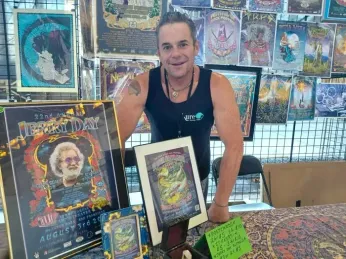
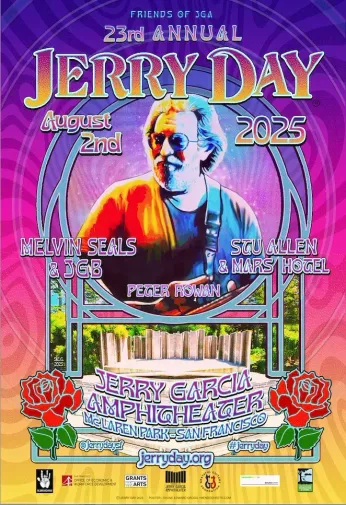
Visual artist Shane Edward Grogg has been a fan of the Grateful Dead since the 1990s. His love of the band motivated his move to the West Coast in the ’90s, where he discovered a burgeoning world of queer Deadheads. He found his tribe! As a graphic artist he has contributed to the visual record of the Dead (no mean feat, given the history of iconic Dead images). Grogg is a six-time winner of the Haight Ashbury Street Fair poster contest and has been the official poster artist for San Francisco’s Jerry Day (Aug. 2) since 2009. Grogg spoke about his art and the community he found in the Bay Area.
Michael Flanagan: Shane, when did you first start listening to the Grateful Dead? How many times did you see them?
Shane Edward Grogg: I first started listening to them in ’87. My first show was summer of ’88 and that was in Landover, Maryland. That was a historic show because they played “Electric Ripple” encore, and that was my first show. I saw 97 Dead shows and about 25 Jerry Garcia Band shows.
When did you move to the California?
I moved to California in October, 1990. I figured if I lived on the East Coast, I could see them two or three times a year, if I lived in California I could go twelve times a year.
How did you connect with community of queer Deadheads? Can you talk a little bit about Queer Deadhead get-togethers?
I was completely closeted in the gay scene, and none of my Dead friends knew. It wasn’t until I had moved to California and I started coming up to the Bay Area. Someone in a parking lot had a T-shirt on that had the ‘Steal Your Face’ with a pink triangle and it read, “Ain’t No Time to Hate.” I stopped him and asked, “What’s up with this shirt?” I had never seen any sort of outward thing like that.
I would wear a rainbow necklace or just a little rainbow pin and I would feel that everyone was looking at it. I started talking with him and he said that there was a whole group of queer Deadheads that were based in San Francisco. They had get-togethers and picnics and they all sat at shows together. He said there was a head shop on Haight Street where it was all based called Distractions (it just recently closed).
We were up here for Shoreline, so the next day I went to the Haight and went to the store and I met all these people – and that night at intermission you met up with each other. I slipped away from my friends at intermission and met all of these gay and lesbian Deadheads and I went back into the show and I knew that my life had changed.
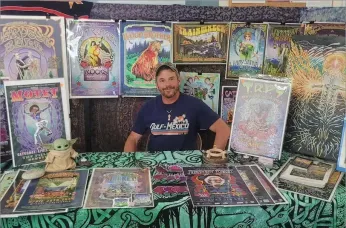
And I decided right then and there that I was going to move from L.A. to San Francisco. It was just the idea that those two parts of my life could coexist with others, it was sort of an awakening of, “Okay, now I really know I belong in San Francisco.” I moved and a couple days from moving I met my ex-partner. He was a Deadhead and had never met another gay Deadhead. We were together for many years.
The queer Deadheads, the original group (the O.G.s) in pre-internet days, pre-cell phone days, was a mailing list and a newsletter. There were loosely organized people in San Francisco and the main thing we did is that we would all sit together at shows. A couple of people would go in early and save a bunch of seats so that we could all be sitting together.
They’re still around. A friend of mine, Joe Rivera, sort of runs the queer Deadheads as they are now. You can find it on Instagram. With the internet and social media, it’s nationwide and people meet up at shows all around the country. There are plans for the 60th anniversary. There’s a meetup at the Pilsner Inn. I’m coming down for all of that, I’m really looking forward to it.
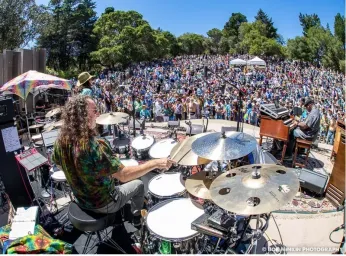
Do you feel that your work has been influenced by the classic psychedelic artists who worked with The Dead, like Stanley Mouse, Alton Kelley, Rick Griffin, Wes Wilson, and Victor Moscoso?
Yes, absolutely, especially Stanley Mouse. He’s probably one of my biggest influences. I was aware of him, without knowing it early on because he did album covers for Journey and other bands. I didn’t know anything about the Grateful Dead at that time, but I loved rock and roll and I loved album cover art. It made me want to be an artist and learn how to airbrush. Later, when I got into the Dead, I put it together; that’s the guy who did Journey! I was influenced by him long before I knew about the Dead.
Once I got to San Francisco and wanted to be a poster artist I loved the original ones, especially Alton Kelley, because I loved Kelley’s lettering and font style.
When did you start working as a poster artist?
Once I got to San Francisco and was living in the Haight I started entering the Haight Ashbury Street Fair poster contest. I won in my first year. I won three years in a row, so I won in ’94, ’95 and ’96 and three times since then. It was in the early ’90s, but I really started focusing on it when I started doing Jerry Day posters, which was in 2009.
How do you feel that art based on the music of the Grateful Dead speaks to the current era?
With Illustrator and digital art, it’s a lot more streamlined and cleaner. That kind of speaks to the new generation of digital kids who have grown up with their iPads. They create something and put it on TikTok or Snapchat. It gets seen by a lot of people.
Has the technology engendered a new sense of community, has there been a rekindling of the earlier flame?
The flame was always there, especially with the queer Deadheads on Instagram. Before we would print up a newsletter and mail it or email it, but now there are thousands of people who are connected. It definitely creates a community vibe. Because now there are hundreds of people know that if they’re in town on Sunday they can come to the Pilsner Inn and that’s where the queer Deadheads are going to meet up.
Back in the old days you might write a note and stick it on the message tree, but now that’s in your phone – it’s in your hand. It’s an easier way to find everybody. When I was coming up, I didn’t think there were any queer Deadheads. Now, especially kids coming up, they already know that we’re here for them.
You have been designing posters for Jerry Day since 2009. What messages do you hope that your fans and people who view your art come away with?
[Laughs] my fans! I would hope people realize how amazed I am that thirty years ago I was sketching Jerry and trying to sell posters on the lot. I’d like people to know that I never stopped loving Jerry. When he died some people thought, ‘Oh, that’s it, it’s over – the best part of my life is over.’ I kind of thought that, but here we are thirty years later and Jerry and his music (and the Grateful Dead in general, but more specifically him) has always been a part of my life and always will.
It’s my great honor and pleasure every year get to create my own tribute to Jerry. Every year I do some version of him and try to make each one better. We all loved him and we all miss him and he lives on in our hearts and our memories and he’s still here because the music is here. And we can keep celebrating him forever.
Jerry Day with Melvin Seals & JGB with Mads Tolling, Stu Allen & Mars Hotel, August 2, 11:30am-6pm, at the Jerry Garcia Ampitheatre, 40 John F. Shelley Drive, McLaren Park, plus other events.
https://www.jerryday.org/
https://www.mendocheeto.com/
https://www.instagram.com/queerdeadheads/