4 hours ago
Team Conrad Gets Real During Knicks Game Kiss
READ TIME: 3 MIN.
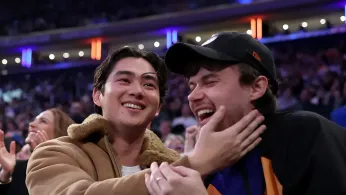
On Friday, November 28, 2025, Sean Kaufman and Christopher Briney, co-stars from the popular Prime Video series "The Summer I Turned Pretty", were attending a New York Knicks game against the Milwaukee Bucks at Madison Square Garden when they became the unexpected stars of the evening. When the jumbotron caught the two actors on camera, Kaufman spontaneously stood up, grabbed Briney's face, and planted a kiss on him—a moment that was captured, shared, and immediately began circulating across social media platforms.
The kiss itself was brief but unmistakable, and Briney's immediate reaction—busting out laughing—only amplified the authenticity and joy of the moment. What could have been a throwaway courtside moment became something more significant: a spontaneous, affectionate gesture between two men in a mainstream sports setting, captured and celebrated by a major sports organization and broadcast to thousands of people in attendance and millions online.
To understand why this moment resonated so deeply, it's essential to understand the show that brought these two actors together. "The Summer I Turned Pretty", based on Jenny Han's bestselling novel series, follows Belly Conklin, a young woman navigating first love and self-discovery during a transformative summer at a beach house. The series has become a cultural phenomenon, but not necessarily for the reasons the original source material might have anticipated. Instead, queer audiences have embraced the show and, more specifically, have become deeply invested in its romantic subplots—particularly the love triangle between Belly and two brothers, Conrad and Jeremiah.
This fandom has created an interesting dynamic: while the show's central romance is heterosexual, queer viewers have found themselves captivated by the emotional complexity, the sibling dynamics, and perhaps most importantly, the homoerotic undertones that permeate the series. The bromance between the two brothers, the tender moments, the rivalry—all of this has been read through a queer lens by audiences who see themselves reflected in the emotional vulnerability and intensity of male relationships on screen.
The Knicks game moment, then, becomes a kind of wink and nod to this queer fandom. The official Knicks Instagram account even posted the clip with the caption "belly, you have some competition," directly referencing the show's love triangle. It's a playful acknowledgment that the show's fanbase extends far beyond the heterosexual romance at its center—and that queer audiences have claimed a piece of this cultural property as their own.
What makes this moment particularly significant is where it happened: at a major professional sports event, broadcast on massive screens, celebrated by a mainstream sports organization. Sports venues have historically been spaces where hypermasculinity is performed, where homophobia has been tolerated, and where queer visibility has been limited or actively discouraged. The kiss between Kaufman and Briney—two men, in a mainstream sports setting, met with laughter and celebration rather than derision—represents a subtle but meaningful shift in how queer moments are being received and normalized in these traditionally heteronormative spaces.
The crowd's reaction and the decision by the Knicks organization to share the moment on their official social media channels suggests a level of comfort and acceptance that would have been unthinkable in previous decades. This isn't a carefully choreographed Pride Night moment or a planned LGBTQ+ visibility initiative—it's a spontaneous gesture of affection between two men, treated as entertainment, joy, and something worth celebrating. For queer audiences who have historically been made to feel unwelcome in sports spaces, this normalization of queer joy is significant.
For queer audiences who have often been taught to hide, minimize, or contextualize their affection, seeing two men kiss in public—even in jest—and have that moment celebrated rather than condemned, is powerful. It's a small but meaningful representation of a world where queer intimacy is normal, expected, and worthy of celebration.
This moment also arrives at an interesting time for "The Summer I Turned Pretty" itself. Prime Video confirmed that Season 3, which premiered earlier in 2025, would be the show's final season. However, the story isn't ending entirely—the series will continue with a film, though an official release date has not yet been announced. Creator Jenny Han has also expressed openness to expanding the universe with additional spin-offs and stories, suggesting that the world of "The Summer I Turned Pretty" still has room to grow and evolve.